


How Martial Arts Naturally Develop Strong Leadership Skills
- Master Brett Nelson
- Feb 1
- 4 min read
Leadership isn’t something you suddenly “switch on.” It’s something you grow into — decision by decision, class by class, lesson by lesson.

In martial arts, leadership develops almost without you noticing. One day you’re focused on your own stance and balance. Then you realise others are watching how you stand. How you respond. How you show up.
At Family Martial Arts Centres, leadership is not treated as a bonus skill or an end goal. It is part of the training itself — supported by your Instructor, your Centre environment, and structured Instructor Training Programmes that allow leadership to emerge naturally, at the right pace, for the right people.
Because strong leaders are built, not forced.
Martial Arts Leadership Starts Long Before You Teach
Martial arts has never been just about kicks, blocks, and punches.
It is a system designed to develop:
Confidence under pressure
Emotional control
Discipline and responsibility
Awareness of others
And ultimately, leadership through example
That’s why leadership is woven into every level of training at FMAC and sits at the heart of our Leadership Programme, which supports students on their journey toward Black Belt and beyond.
And here’s something interesting:
Most students don’t try to become leaders — they become leaders as a result of consistent training and personal growth.
Leadership Begins With How You Lead Yourself
Before anyone leads others, they learn to lead themselves.
In martial arts, this shows up in simple but powerful ways:
Turning up consistently and on time
Wearing the correct uniform with pride
Staying focused before, during, and after class
Listening with intent — not just to hear, but to understand
Taking responsibility for personal progress
From the very first lesson, students are gently guided to set achievable goals — improving a technique, learning a Hyung, refining balance or timing.

Each small win builds certainty. Each repetition strengthens belief. And over time, discipline becomes part of who they are — not something they have to think about.
That is the foundation of leadership.
Confidence Grows Through Mastery and Repetition
Confidence doesn’t come from being told you’re confident. It comes from knowing you can do something — because you’ve done the work.
Martial arts creates this certainty through structured progression:
Clear syllabus goals
Measurable improvement
Visible milestones (belts, Forms, control, precision)
As students progress, something shifts. They stop looking back and start looking forward.
Instructor Training Programmes gently accelerate this process by offering opportunities to:
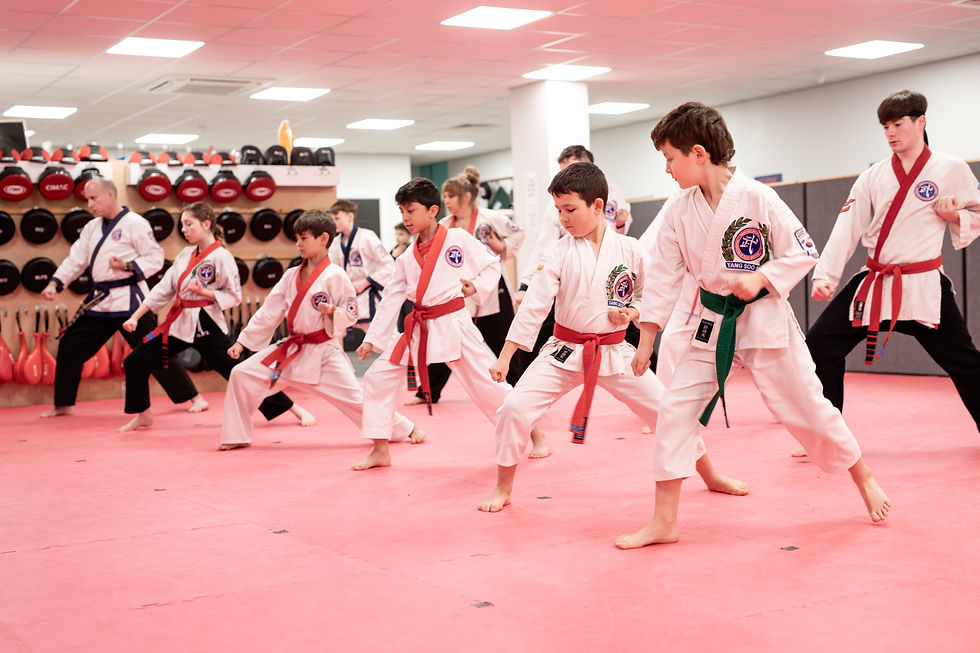
Demonstrate techniques
Assist with warm-ups
Support newer students
Take responsibility in small, supported ways
Each experience reinforces a simple internal message:
“I can do this.”
And confidence naturally evolves into calm, capable leadership.
Learning to Communicate With Clarity and Positivity
Strong leaders communicate in a way that helps others succeed.
While not every student is expected to teach, those who grow most in Tang Soo Do naturally become clearer, calmer, and more encouraging in how they communicate — simply because their understanding deepens.
At FMAC, students are guided to:
Use positive, respectful language
Offer constructive encouragement
Demonstrate techniques accurately and consistently
Adapt communication based on age and learning style
Instructor Training builds on this by transforming experience into awareness.
Through theory and practical sessions, students discover that how something is said often matters more than what is said.
Clear communication becomes a skill — and a leadership trait.
Empathy and Patience: The Quiet Strength of Real Leaders
True leadership is not about authority. It’s about understanding.
Every student progresses differently. Some excel physically. Others mentally. Some struggle early and flourish later.
Instructor Training Programmes place strong emphasis on empathy, helping students learn to:
Recognise different learning speeds
Support without judgement
Encourage without pressure
Celebrate progress, however small
When students help others — especially beginners — something powerful happens.
They begin to see potential in others… often before those students see it themselves.
That is leadership in its purest form.
Teamwork Turns Individuals Into Leaders
Although martial arts is a personal journey, no one trains alone.
At all FMAC Centres, teamwork is central to creating a safe, focused, and respectful training environment. Students learn to work:
In pairs
In groups
Across age ranges
Within structured class settings
Instructor Training gives practical experience in:
Partner drills and coaching
Small group demonstrations
Collaborative teaching exercises
Mentorship and support roles
This teaches an essential lesson:
Leadership is not about standing above others — it’s about working with them.
Leadership Develops Best With Guidance and Support
One reason FMAC Instructor Training Programmes are so effective is the environment they create.
Trainees receive ongoing guidance as they learn to:
Lead sections of a class
Manage energy and attention
Motivate mixed age groups
Maintain safety, structure, and standards
Mistakes are expected. Growth is encouraged. Feedback is constructive.
This allows students to step into leadership roles with confidence — knowing they are supported every step of the way.
Leadership That Extends Beyond the Do Jang
The behaviours learned through martial arts leadership naturally transfer into everyday life.
Students often notice improvements:
At school – increased focus, confidence, teamwork
At work – reliability, communication, self-discipline
At home – responsibility, respect, positive role-modelling
In the community – calm confidence and leading by example
Leadership stops being something you do…and becomes something you are.
Leadership Starts When You’re Ready
At North Manchester Family Martial Arts Centres, we are proud to develop not only skilled martial artists, but confident, capable leaders.
Our Instructor Training Programmes exist to support students who naturally feel ready to take the next step — whether that means helping others, deepening their understanding, or exploring where their martial arts journey could lead.
Because leadership is not a title. It’s a way of showing up — on the mats and in life.
If you’d like to learn more about Instructor Training, speak to your Instructor or explore further here: www.moodokwan.co.uk/fit
Kyo Sa Nim Nick Ogden

Comments