


The Power of the Kiyap
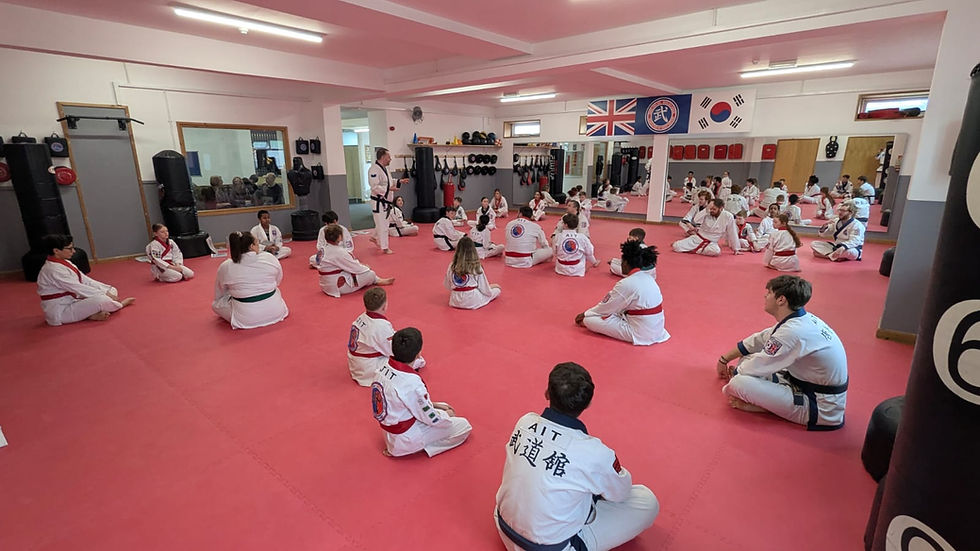
If you’ve ever watched a Tang Soo Do class at one of our centres, or been an observer at Graduation, there’s one thing that probably caught your attention straight away: the kiyap or ‘loud shout’.

That sharp, powerful ‘kiyap’ can sound intimidating at first, but in Tang Soo Do, the kiyap is much more than simply making a loud noise. It has a purpose and learning to use it properly is an important part of the martial arts journey.
The ‘What’
So what is a kiyap? A kiyap (pronounced “kee-ap”) is literally translated as a “spirit shout”. In class, essentially it’s a controlled shout that is used during certain techniques, at certain times. It comes from the idea of bringing together energy and focus at one moment in time. Think of it as putting everything into one action – your body, your breathing, your concentration and your intention.

The ‘How’
Producing a ‘loud shout’ is not simply about yelling at a specific time. Strictly speaking the kiyap should come from the diaphragm, not the throat. We shouldn’t become hoarse and have a sore throat after multiple kiyaps. The kiyap in Tang Soo Do is best thought of as a sharp, controlled exhalation with a vocal sound, rather than simply shouting as loud as possible. A kiyap is as individual as someone’s spoken voice, and in the Do Jang I‘ll bet the Instructors can identify each student blindfolded from the individual kiyaps they hear during classes. To some it is an ‘A’ sound, and to others perhaps a ‘Hup’ or ‘Hah’. In Tang Soo Do the sound should be short, loud and focused and the abdominal muscles should tighten as the body exhales. It’s fairly common that students may initially imitate their Instructor’s kiyap at the start of their training, but that this will become more individualised over time.
The ‘Why’
As a beginner, it’s common to feel self-conscious about ‘kiyaping’ in class. As we progress, however, it becomes more natural and an instinctive part of our training. So why is a ‘kiyap’ so important?

Tradition: in Tang Soo Do, the kiyap is deeply rooted in tradition. It represents the expression of the ‘kee’ (or ‘chi’), which is our ‘internal energy’. By externalising the inner ‘kee’ through a loud shout it helps to gather strength and power in the move or technique, and also symbolises determination, presence and disciplined spirit.
Getting attention: if we are being attacked, using a powerful voice can attract attention and get help from others around us. We practise kiyaping in class so that if we needed to use it in a real life situation (hopefully never) it would feel second nature and be an automatic response.
Showing confidence: a powerful kiyap can momentarily distract, or scare our opponent if we are being attacked, and can give the impression we are not scared, despite how we may be feeling underneath.
To tighten abdominal muscles: the brief exhalation and abdominal engagement can help co-ordinate the body at the exact moment of impact (such as a strike).
Timing: it helps co-ordinate breath, body and technique at the precise moment, for example during a hyung (a Form or pattern).
The ‘When’
The simple answer to this is “whenever my Instructor tells me to”. But more broadly speaking, the tradition is that we kiyap:
on the first and last move of a training drill
when we perform a turn or change direction
when we perform a different move from the previous drill. If we have been doing low blocks, for example, and then we are suddenly asked to do a high block, the kiyap would indicate the first move of the new drill or technique.
during certain points in the Tang Soo Do Hyungs (or patterns). From our first hyung as a blue belt (Cho Bo Ja Hyung), to the Pyung Ahn forms on the way to black belt, the correct use and placement of the kiyap is very important. A strong, confident kiyap in the right place, at the right time, helps focus the energy and timing of the move and it shows intent and decisiveness in the performance of the hyung. A lacklustre kiyap or lack of kiyap altogether, unfortunately, can show the opposite – an absence of confidence and not enough understanding or knowledge of the correct pattern.
Kiyap Takeaways:
The kiyap is more than a loud shout. It prepares the mind, focus, energy and body to help execute sharp, confident moves. This is not only during training drills, but when we’re also performing Hyungs. It’s part of our Tang Soo Do tradition, and learning to kiyap in the right way, at the right time is an integral part of our martial arts training. So….don’t forget to kiyap!
Kyo Sa Nim Carol Plummer


Comments